Zone Pushers
January 4, 2023 | EDUCATION

I have a confession to make: I am a zone-pusher from way back.
I didn’t know I was a zone-pusher until I stumbled across a group of the same name on Facebook. Reading through the posts from gardeners all over the US, Canada and international locations, I had an instant connection with them that led me to the realization that I, too, am a zone-pusher.
What is a zone-pusher, you might reasonably ask? We are gardeners who, through knowledgably flouting the collective wisdom or through unintended ignorance or through sheer determination, grow plants in our landscapes that are not supposed to overwinter in our USDA Hardiness Zone. For those who are not familiar with the USDA Hardiness Zones, they are represented on a map created with decades of weather data. Each zone has an average low temperature for winter. So, for example, Pittsburgh Botanic Garden is in USDA Hardiness Zone 6a, with an average low temperature (-10 to -5 degrees F/ -23.3 to -20.6 degrees C). Personally, I push that to Zone 6b (-5 to 0 degrees F/ -20.6 to -17.8 degrees C). That may seem like quibbling, but those few degrees warmer open up a whole list of plants that you can grow and assume that they will overwinter for you. Crepe myrtles, anyone?
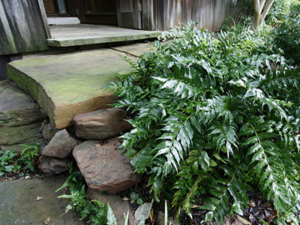
Holly fern (Cyrtomium falcatum). Image courtesy of University of Florida Gardening Solutions.
Seasoned zone-pushers use a number of techniques to accomplish their goal of growing that plant you loved in South Carolina in your northern landscape. First, we all know those really hardy cultivars – like ‘Edith Bogue’ or ‘Bracken’s Brown Beauty’ southern magnolia (Magnolia grandiflora). Second, we know how to create microclimates in our landscapes. I have a holly fern (Cyrtomium falcatum) growing in the sheltered shade next to my house. The lack of blasting winter winds and little bit of extra warmth coming from the house makes all the difference. There are expert zone-pushers who box up their windmill palms or provide a heat source for their Yucca rostrata, which is more than I am willing to do because I’m also a lazy gardener.
I have had the privilege of learning from great zone-pushers in my past without even recognizing that they were pioneers. J.C Raulston was planting USDA Hardiness Zone 9 plants at the arboretum later named for him in North Carolina way back in the 80’s. He’d always chide me about feeling so guilty when my native-to-Georgia plant died. “Get over it, it doesn’t make you a bad person,” he’d say. “Push the envelope.”
Are you a zone-pusher? It’s okay if you are. Take pride in your successes and don’t feel guilty about the failures. You can always try another species.

Education & Exhibits Director
Pittsburgh Botanic Garden


 Trillium